In our last post on the history of asbestos, we explored how ancient civilizations made use of this seemingly unthreatening fibrous mineral.
Centuries ago, before asbestos was found to be the primary cause of mesothelioma, asbestos mining could be traced back thousands of years to before the construction of the Great Pyramids.
For most of that ancient history, though, asbestos was used for one of two purposes:
- To keep ashes from mixing with the funeral pyre during cremations, when the body would be wrapped in a flame-resistant asbestos cloth
- To impress visitors from foreign lands with fire-resistant party tricks
While there were other uses, some of the records were lost as the ancient era entered the medieval and renaissance periods. It was the European Dark Ages after all — a time of civilizational decline.
By the Middle Ages, asbestos began to take on new uses beyond jaw-dropping theatrics.
Asbestos Party Tricks Continue in the Middle Ages
It’s recorded that the court of Charlemagne, the first Holy Roman Emperor who is often referred to as the “Father of Europe,” used asbestos in various ways to entertain those around him.
One legend tells of how he would host luxurious banquets on a white tablecloth woven from pure asbestos. After the feast, he would toss the tablecloth into the fire to amaze guests when it refused to burn. The cloth would then be laid back out on the table unharmed and clean as ever.
Similar stunts were also pulled in China. One story tells of a Han Dynasty emperor who used a jacket woven with asbestos to prevent wine stains, much like a modern stain-resistant fabric.
For years, it seems as though this toxic mineral was still primarily used for party tricks. However, that all changed during the Crusades, when asbestos began to take on a more practical and dangerous role.
Asbestos in Medieval Warfare
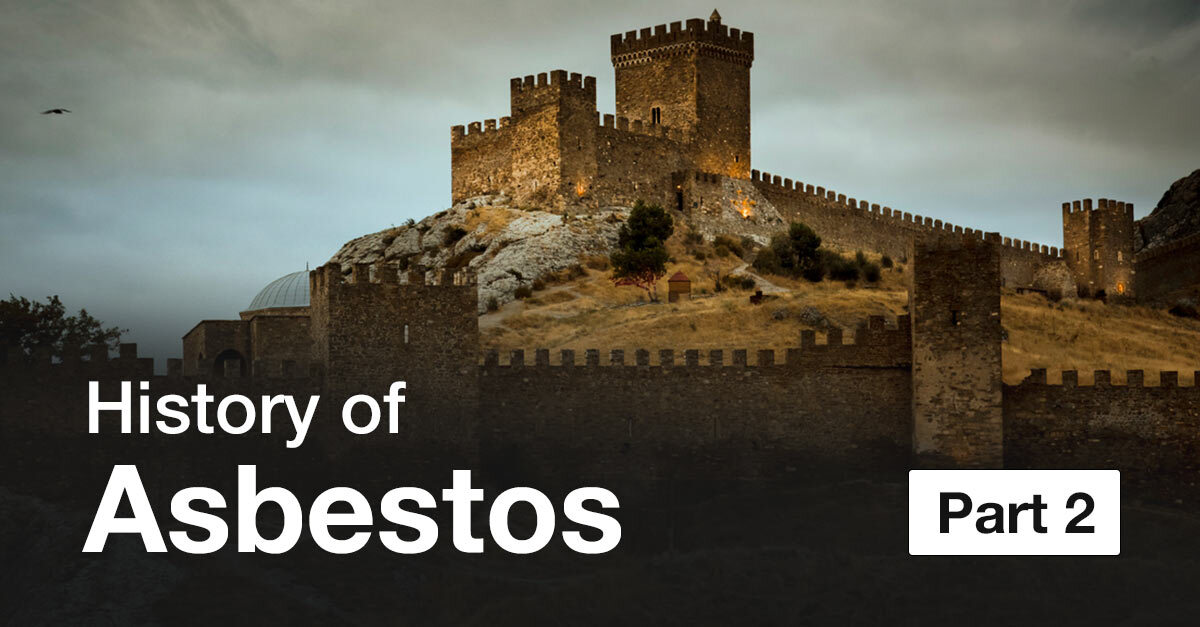
In the 11th century, knights and soldiers from all over Christian Europe marched on the Byzantine Empire to reclaim the holy lands then occupied by Muslim forces. Some of those armies had a new weapon called a trebuchet, a large catapult that could fling missiles over the walls of besieged cities and castles.
According to some reports, in the year 1095, French, German, and Italian knights used a trebuchet to hurl flaming bags of tar wrapped in asbestos. It’s likely the asbestos cloth was used to contain the fire until the impact splattered flaming tar over any enemies or buildings in the path of the bags.
At this point, the carcinogenic nature of asbestos still wasn’t well known. However, its use in siege weaponry offered a frightening foreshadowing of the lives asbestos exposure would later take.
Marco Polo Investigates Asbestos
In the late 13th century, the famed Venetian merchant and explorer Marco Polo traveled along the Silk Road to China, Persia, India, Japan, and much of the Mongolian Empire. His writings about his experience provided Europe with an early account of the inner workings and cultures of Asia.
In one anecdote, Polo described a Mongolian practice involving a fireproof material, which was attributed to the skin of a magical salamander.
At the time, Marco Polo wrote:
“He said that the way they got them was by digging in that mountain till they found a certain vein. The substance of this vein was then taken and crushed, and when so treated it divides as it were into fibers of wool … These were then spun, and made into napkins. When first made, these napkins are not very white, but by putting them into the fire for a while, they come out as white as snow. And so again whenever they become dirty they are bleached by being put in the fire.”
Often one to refute the marvelous claims of other travelers, Polo wanted a more realistic explanation, so he sought out the material’s origins.
It’s reported that Marco Polo visited an asbestos mine in China to disprove claims that asbestos came from the hair of a lizard and was, in fact, a naturally occurring mineral.
Nonetheless, these murky anecdotes about magical lizards lasted until the Age of Enlightenment and Scientific Revolution.
Asbestos Enlightenment Leads to an Industrial Age
Centuries after its use in medieval warfare and magic tricks, the truth about the mysterious fire-resistant fiber was determined. In 1642, the English physician Sir Thomas Browne properly attributed those fire-resistant properties not to a lizard but to a mineral known as asbestos.
By this time, civilization was entering an era of reason, logic, and science. Yet, for all the wisdom of the Enlightenment, the same scientific principles gave rise to the Industrial Revolution and triggered an era of incredible economic greed.
It was in the 19th century when asbestos began to be mined and put to use on a truly globe-spanning, commercial scale.
Civilization was, once again, undergoing a massive change. Capitalism emerged as the dominant economic system, and with it came the ruthless dictates of supply and demand. When it came to asbestos, a company’s profit overpowered any concerns about its long-term effects on public health.
In our next installment on the history of asbestos, we’ll look at asbestos during the industrial era and how its many profitable uses transformed asbestos into the widespread, insidious substance we now know it to be today.
Asbestos Still Isn’t a Thing of the Past
As a trusted national asbestos exposure law firm, Simmons Hanly Conroy is dedicated to helping mesothelioma patients and their families get justice.
One of the first things our mesothelioma attorneys hear from clients is, “How did this happen? How could companies get away with using something as dangerous as asbestos?”
It’s important to understand the history of how this dangerous mineral was used, when companies realized its potential worth, and how Americans were put at risk as a result.
Learn More About the History of Asbestos
Visit our previous and next installments on the history of asbestos now:
- History of Asbestos, Pt. 1: Asbestos in the Ancient World
- History of Asbestos, Pt. 3: Asbestos in the Industrial Age
- History of Asbestos, Pt. 4: Asbestos from Its Heyday to the Era of Regulation
- History of Asbestos, Pt. 5: Asbestos in the Present Day
Contact us now to learn more about your legal options for free if you or a loved one has been diagnosed with mesothelioma.