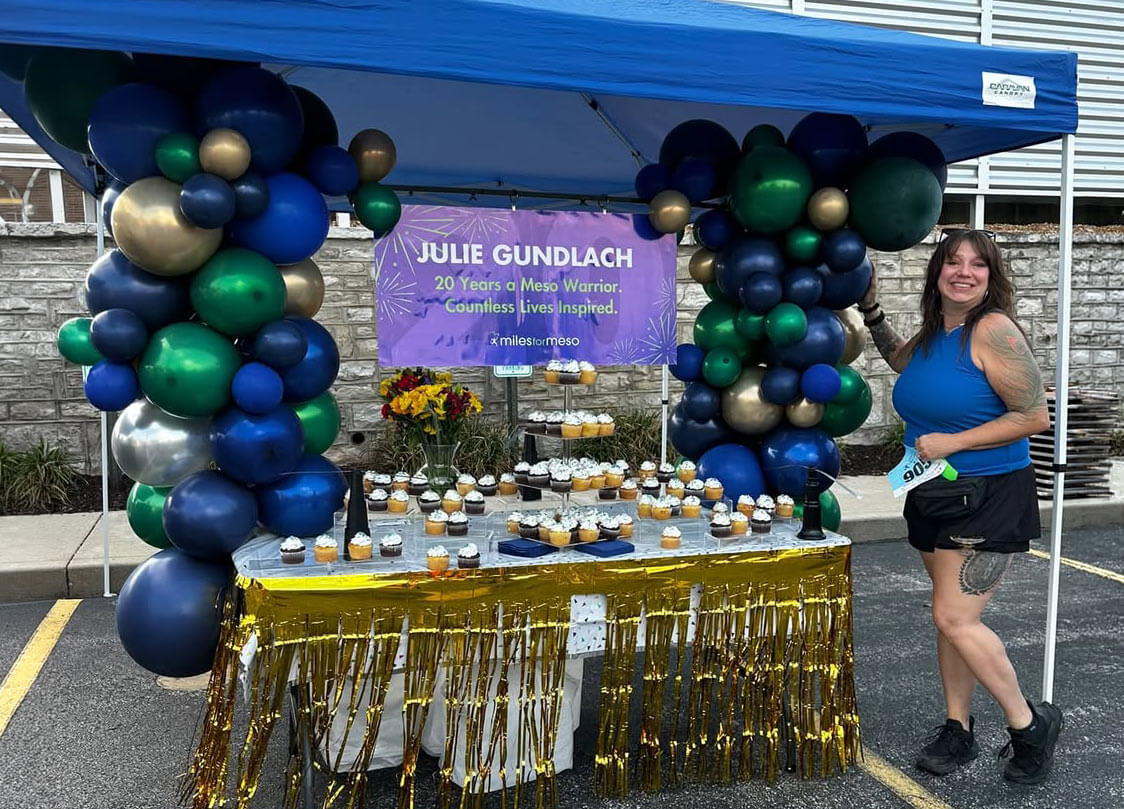
As a leading national asbestos law firm, Simmons Hanly Conroy is highlighting the stories of mesothelioma patients like Julie Gundlach who inspire us with their courage and resilience.
Since her diagnosis in 2006, Julie has refused to let cancer define her life. Now, as a 20-year mesothelioma survivor, she is still battling and sharing her amazing story with people across the country. Her hard-won survival is symbolic of the incremental change that the asbestos awareness community fights for every day.
In fact, Julie helped spark the idea for Miles for Meso while talking with her attorney at the firm. The event has since grown into a nationwide movement for mesothelioma awareness.
On September 19, 2026, our firm will host the 18th Annual Alton Miles for Meso 5K Race & 3K Fun Run/Walk, bringing hundreds of virtual and in-person participants together behind a united cause: raising awareness and funds for mesothelioma.
Find out more about Julie’s journey and how you can support families like hers at this year’s Miles for Meso event.
A Shocking Diagnosis
Mesothelioma is a rare form of cancer that most commonly impacts men over the age of 65. So when Julie began experiencing digestive issues in her 30s, this particular disease didn’t cross anyone’s mind.
Doctors thought she had ovarian cancer, but during surgery, they were shocked to find it was actually peritoneal mesothelioma, which forms in the lining of the abdomen (peritoneum). Before she got sick, Julie had never even heard of these terms.
“I felt like I was a high school dropout attending master’s-level classes when I first stepped into this world,” said Julie.
After her diagnosis in August 2006, Julie’s life changed abruptly. At the time, her daughter was only 3 years old.
“My biggest fear was that my daughter would grow up and not remember her mother,” Julie reflected.
She was advised to talk to a mesothelioma lawyer and make sure her affairs were in order. The shock of the prognosis shattered her world, but she decided to fight back.
Julie’s Battle Against a Preventable Cancer
Determined to beat the odds, Julie sought out the best care possible. Unfortunately, this often required cross-country trips to mesothelioma specialists.
To make matters worse, Julie’s insurance companies looked for any way to deny her medical coverage. They called her treatments “experimental” and refused to compensate her. The insurers also claimed she was out of network.
Julie persevered. Throughout her difficult treatments, her loved ones supported her and carried the household burdens. She also connected with the asbestos prevention community, allied with Simmons Hanly Conroy, and fought for access to life-saving treatments.
“The compensation I received has allowed me to seek the medical treatment that I absolutely need without the fear of losing my home,” said Julie.
Julie is now a long-term mesothelioma survivor, far outliving her initial prognosis. She has provided vital support to countless families impacted by mesothelioma — and has had the joy of watching her daughter grow up.
“Every time I see a milestone — when I see prom, when there’s high school graduation, first relationship, and now college graduation — it’s so overwhelming to know that I get to be there,” Julie said. “I thought, ‘I’m not even supposed to be here. It’s such a miracle that I’m there.’”
Celebrating 20 Years as a Long-Term Mesothelioma Survivor

Today, Julie is a 20-year mesothelioma survivor, and she has been treatment-free for over 10 years. She continues to get checkups every year and is part of a long-term survivorship study.
Julie believes it’s important to speak openly about her diagnosis to raise awareness about the ongoing dangers of asbestos, especially given that the substance still isn’t fully banned in the U.S. Her experience is also proof that a dire diagnosis doesn’t have to be the end of the story.
“When I reflect on 20 years of survival, it’s with a sense of disbelief and gratitude, still tinged with sadness and anger too,” said Julie. “I often wonder what the last 20 years would’ve looked like had not so much of it been stolen by mesothelioma.”
By sharing her journey, Julie hopes to inspire others facing a mesothelioma diagnosis to hold onto hope and keep fighting.
“My advice to anyone who has been recently diagnosed is to tap into a support system wherever you find it. Find yourself some legal help and representation, and do whatever it takes to save your life,” Julie expressed. “Go to any length, go to any hospital, find the best person to treat you that you can because your life is all you have and you have to fight for it.”
She’ll be sharing more of her story on August 18 during a live webinar hosted by the Asbestos Disease Awareness Organization (ADAO).
The Dangers of Secondhand Asbestos Exposure
As Julie’s story proves, there is no such thing as a typical asbestos victim. While she may not have worked in an occupation at risk of asbestos exposure, her dad did.
As a union electrician, he provided light and power to thousands of residents and businesses throughout his career. While he drilled through walls and ran wires, asbestos dust entered his lungs and covered his clothes.
When Julie and her sister welcomed their dad home from work, his clothes still had the toxic dust on them. At their house, the laundry room also doubled as the playroom.
No one in her family knew about the dangers of secondhand exposure, and Julie likely swallowed or breathed in microscopic asbestos fibers at home.
The widespread use of asbestos throughout the 20th century also meant that Julie may have been exposed to this toxic mineral in other ways too, from the tiles in her family’s home to the brake pads in their cars.
“Making a Profit Off People’s Pain Is Wrong”
Many asbestos companies that employed union workers knew their products were dangerous. They also knew asbestos was cheap and durable, so they chose to hide these dangers from the public to protect their profits.
Since mesothelioma can take 10 to 50 years to develop after exposure, companies thought they could get away with exposing their workers and the public to asbestos for decades.
“While there’s a lot of gray in this world, I also know that there is right and there is wrong,” Julie said at an asbestos advocacy conference. “Making a profit off people’s pain and lives is wrong. And I will not stop until we have a ban on asbestos.”
Now, patients and their loved ones can file mesothelioma lawsuits against these companies to hold them accountable for the pain they’ve caused.
Along with building a sense of shared purpose among those directly affected by mesothelioma and asbestos-related diseases, Miles for Meso provides an opportunity to be seen and heard by the public at large.
“Miles for Meso means that somebody has my back — and somebody is amplifying my voice against the use of asbestos and the industry of corporate greed,” Julie explained.
Support Families Impacted by Mesothelioma at Miles for Meso
Like Julie, most people are not aware of the dangers of asbestos until long after they’ve been exposed. The more people know about the toxic fiber lurking in their homes, schools, and workplaces, the better.
To raise awareness about the dangers of asbestos and show your support for families impacted by mesothelioma, consider participating in Miles for Meso either in person or virtually.
Participants can register for the race until:
- August 23 for $40
- September 6 for $45
- September 13 for $50
For your support, you’ll receive a free swag bag that includes a Miles for Meso shirt and other special items. All registration proceeds from the Alton, Illinois race will benefit the Asbestos Disease Awareness Organization (ADAO).
On the day of the race, you can share a picture of yourself running or walking with the hashtag #MilesForMeso on social media to help spread awareness about mesothelioma and the dangers of asbestos.
Join all of us at Simmons Hanly Conroy in fighting for mesothelioma patients like Julie. If you or a loved one has been diagnosed with this cancer, contact us now to see if we may be able to help your family.